

KEY POINTS
-
Mahama wants Ghana to end raw mineral ore exports by 2030.
-
Ghana is promoting local refining, processing and manufacturing to create jobs and retain more value.
-
He urged African countries to cooperate on investment, fair taxation, regional trade and environmental protection.
Ghanaian President John Dramani Mahama has urged African countries to stop exporting raw minerals and instead process them locally to create jobs, strengthen industries and retain more economic value within the continent.
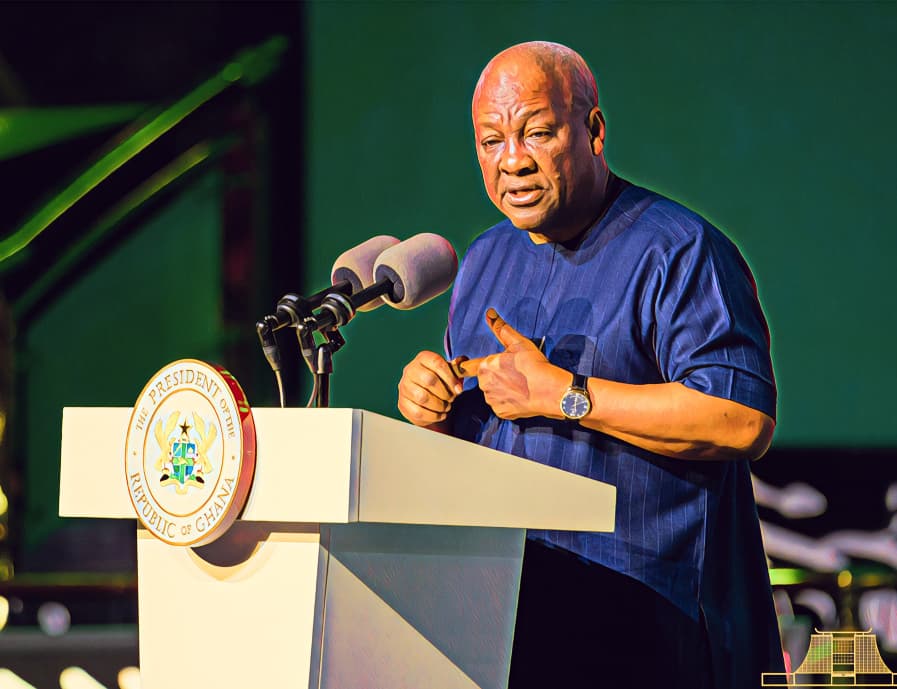
Speaking at the opening of the second Mining in Motion Summit on October 20, 2026, Mahama called for greater cooperation among African countries to develop mineral-processing industries, improve regional trade and ensure communities benefit fairly from natural resources.
Mahama said Ghana was pursuing a phased restriction on exports of unprocessed mineral ores, backed by legal measures, mineral-specific requirements and transparent implementation timelines.
He said the country had already banned exports of iron scrap and non-ferrous metals, adding that his goal was to ensure raw mineral ores no longer left Ghana by 2030.
The president said resources such as alumina, manganese, iron and lithium should support domestic processing and industrial development instead of being exported mainly as raw materials.
The policy is intended to encourage investment in local industries, create employment and allow Ghana to capture more value from its mineral resources.
Government promotes mineral-processing industries
Mahama said Ghana had established institutions and frameworks to connect mineral extraction with local manufacturing.
The Ghana Integrated Aluminium Development Corporation provides a framework for linking bauxite mining to aluminium refining, smelting and manufacturing.
Similarly, the Ghana Integrated Iron and Steel Development Corporation is working to connect iron ore development with commercial steel production.
Mahama also pointed to the Ghana Gold Board and the country’s gold-refining policy as part of efforts to retain more value through gold assaying, refining and related services.
These initiatives are designed to strengthen domestic industrial capacity and reduce reliance on exporting minerals without substantial processing.
Africa should export finished products, not just raw materials
The president called for African mineral resources to be transformed into higher-value products before export.
He identified electric vehicle batteries, electric cables, transformers, finished aluminium components and rare-earth magnets as examples of products that could be manufactured using the continent’s mineral resources.
Mahama argued that regional processing agreements should deliver genuine industrial transformation and fair economic benefits to participating countries.
He also called for improvements in intra-African trade, including the implementation of tariff commitments, removal of non-tariff barriers, simpler customs procedures and better transport and payment systems.
According to him, these measures would make it easier for African businesses to obtain inputs from other countries on the continent and sell finished products across regional markets.
Mahama welcomes foreign investment but demands stronger partnerships
Mahama said Africa was not opposed to foreign capital or foreign direct investment, stressing that international investors could play an important role in developing the continent’s mineral-processing industries.
He encouraged investors to bring capital, technical expertise and technology while partnering with African businesses to establish competitive industries locally.
However, he urged African leaders to cooperate more closely on fair taxation, responsible mining and meaningful local participation.
He warned against agreements that create divisions between African countries and weaken their collective bargaining power when negotiating with international investors.
The president’s position was that African countries should coordinate their mineral policies to secure better economic returns while maintaining opportunities for international partnerships.
Environmental protection and community benefits remain priorities
Mahama said mineral development must protect people’s lives, livelihoods and the environment.
He stressed that communities affected by mining should receive a fair share of the benefits, while workers must be protected and mined land properly reclaimed and rehabilitated.
He also called for mineral revenues to be transparently accounted for and used in the interests of citizens.
For Ghana, he said, preventing and reducing mining-related environmental damage remained an additional priority, particularly given the importance of rivers, forests and farmlands to local communities.
The president’s remarks linked the push for local processing with the need to ensure mining contributes to sustainable development rather than imposing lasting environmental and social costs.
African Union official points to Ghana’s gold reforms
Francisca Tatchouop Belobe, the African Union Commissioner for Economic Development, Tourism, Trade, Industry and Minerals, said Ghana could provide useful lessons for other African countries.
Citing the Ghana Gold Board as an example, she highlighted the country’s efforts to strengthen the management and value retention of its gold resources.
Liberian Vice President Jeremiah Kpan Koung attended the summit. The Asantehene, Otumfuo Osei Tutu II, was represented by the Omanhene of Asumenya, Odeneho Okyere Kusi Ntrama II.
The summit’s discussions centred on the need for African countries to align their mineral policies and develop greater capacity to process and manufacture products from resources extracted across the continent.