

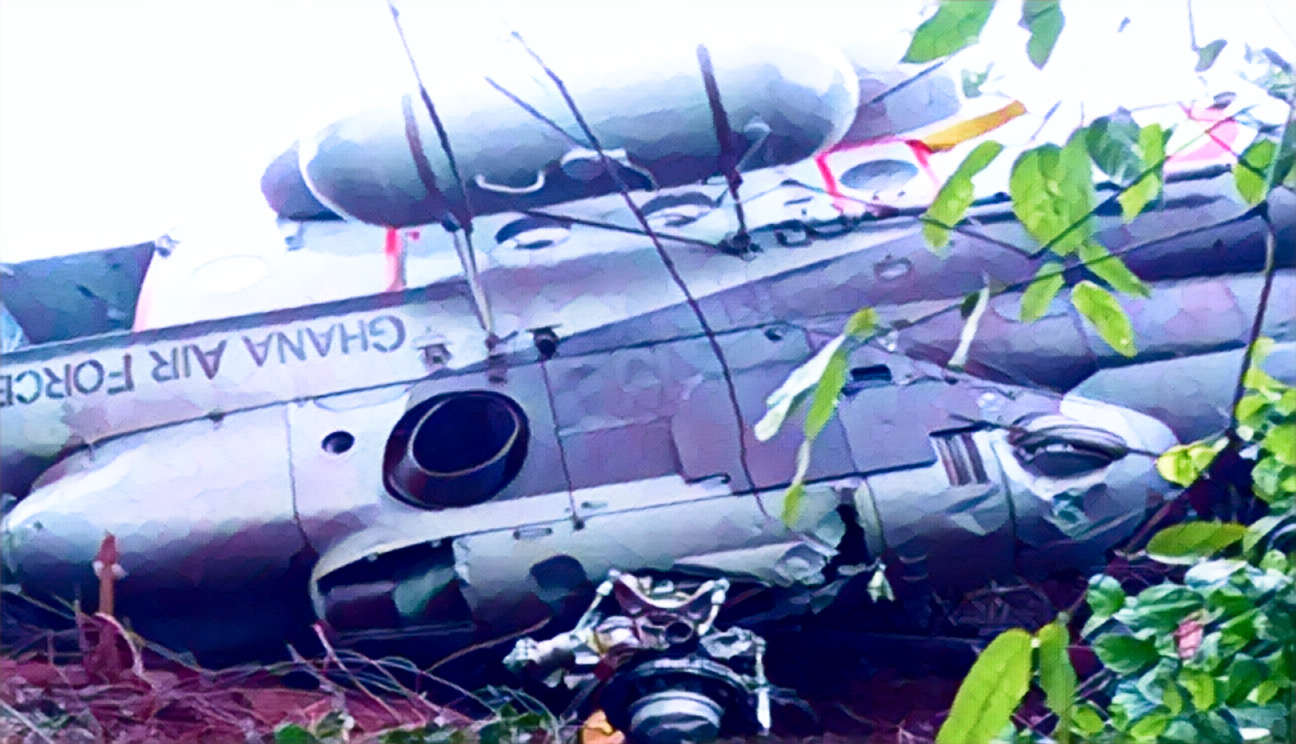
KEY POINTS
- Downdraft and poor weather caused sudden loss of lift.
- Helicopter lacked critical safety systems for high terrain.
- Systemic gaps in navigation and training further contributed to crash.
The long-awaited investigation into the August 6, 2025, crash of a Ghana Air Force Harbin Z-9 helicopter reveals how the accident killed eight high-ranking officials and crew members.
Compiled by a joint board from the National Security, Ghana Armed Forces, AIB Ghana, and assisted by US officials, the Ministry of Defence Accident Report analysed flight data, cockpit recordings, wreckage, weather, and witness accounts to determine the cause.
Captain Paul Forjoe, a retired pilot and AIB Ghana investigator, presented the findings at Jubilee House on November 11, highlighting a combination of adverse environmental conditions and also systemic safety deficiencies.
Sudden downdraft and adverse weather caused crash
The investigation concluded that the immediate cause was a sudden loss of lift due to a downdraft, occurring without any change in power or pitch from the crew.
Furthermore the helicopter flew over high terrain with poor visibility, creating turbulent wind currents. Limited en route weather information meant the crew relied only on reports from Accra and Kumasi, which showed low clouds and poor flying conditions.
The helicopter transitioned from Visual Flight Rules (VFR) to Instrument Flight Rules (IFR) near the crash site but lost control and impacted a ridgeline at 1,370 feet above sea level, roughly 6.5 miles from Obuasi.
Systemic safety gaps also highlighted in report
Although the aircraft was deemed airworthy, it lacked critical modern safety enhancements such as:
Terrain Awareness and Warning System (HTAWS/EGPWS)
Advanced navigation with terrain mapping
Automatic Flight Control System (AFCS)
The investigation also noted limited national navigational capabilities, absence of real-time flight monitoring systems, and no access to simulator training for the crew.
Investigators ruled out human factors, noting that both pilots were FAA-certified and medically fit, and concluded the crash resulted from environmental and systemic issues rather than crew error.